
Congratulations to Drs. Alexei Novikov, Olga Goriunova and Andrzej Weber on the recent publication of their monograph by Irkutsk State University Press!
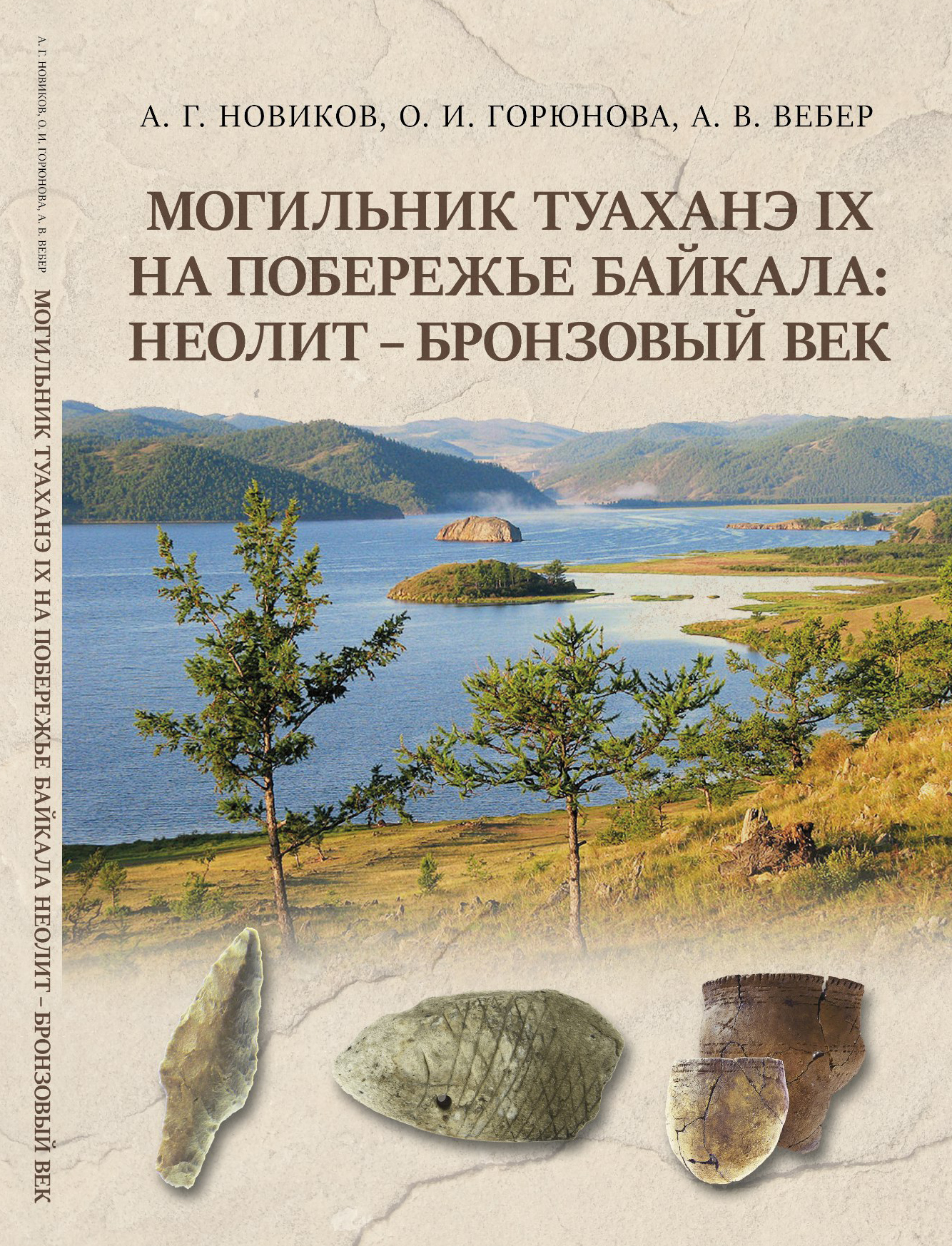
А. Г. НОВИКОВ, О. И. ГОРЮНОВА, А. В. ВЕБЕР: Могильник Туаханэ IX на побережье Байкала: неолит – бронзовый век. Иркутск: ИГУ. 2025. 320 сс.
A.G. Novikov, O.I. Goriunova, A.W. Weber: The Tuakhane IX cemetery on the coast of Baikal: Neolithic – Bronze Age. Irkutsk: IGU. 2025. 320 p.
SUMMARY
This monograph is dedicated to culture-historical analysis of the mortuary assemblages documented at Tuakhane IX – one of the large and completely excavated prehistoric cemeteries of the Cis-Baikal region. Tuakhane IX is located on the cape of the same name on the northwestern coast of the Mukhor Bay of the Little Sea part of Lake Baikal. Comprehensive excavations of this necropolis were carried out in 2019–2022 by the Russian–Canadian archaeological expedition (a joint project between the Research Center “Baikal Region”, Irkutsk State University, and the Department of Anthropology, University of Alberta, Edmonton, Canada). The cemetery dates to two chronologically different periods: the Late Neolithic and the Early Bronze Age. The bulk of the graves (24 of the 31) are Early Bronze Age.
The large volume of the new information provided by the excavated graves as well as the results of the broad range of scientific methods employed in the analysis of these materials made it possible to examine mortuary practices of these prehistoric groups at a qualitatively new level, to develop a typology of grave goods, to propose culture-historical reconstructions and, based on a large number of radiocarbon dates, to determine chronology of these new materials. The monograph employs a wide range of scientific methods from such fields as paleoanthropology, radiocarbon dating, zooarchaeology, mineralogical and petrographic identifications of lithic objects, as well chemical compositional data of metal objects. Stable isotope measurements of carbon and nitrogen (δ13C, δ15N) on samples of human bones were used to assess the diet of these groups.
Chapter 1 provides basic archaeological information related to all subsequent analytical chapters. Detailed descriptions of each grave excavated at Tuahane IX are accompanied by extensive illustrations, including floor plans and sections, photographs, line drawings of grave goods, and summary tables.
Chapter 2 is dedicated to the examination of mortuary practices against a broad culture- historical background. Based on the structural characteristics of the excavated graves (i.e., surface and inside grave pit stone structures), the orientation of graves and burials within as well as additional details on mortuary practices, two homogeneous groups of burials are distinguished at Tuakhane IX: one group (24 graves) is attributed to the Bronze Age, and another (7 graves) to the Neolithic. Mortuary characteristics and spatial organization are analyzed separately for each group. Attention is paid to the preservation condition of the graves and skeletons, sex and age of the burials, as well as the presence and placement of accompanying grave goods.
Chapter 3 presents the results of morphological (typological) analysis of grave goods for each chronological group separately and compares Tuakhane IX grave good assemblages with the materials from other cemeteries known in the Olkhon micro-region of Cis-Baikal. Grave good assemblages of the 1st group of graves (Early Bronze Age) are characterized by items made of metal, stone, bone/antler, and, in rare cases, clay pots. The X-ray spectral analysis of the metal items showed that tin and arsenic bronze, as well as “pure” copper, were used for their manufacture. Among lithic objects, many utilitarian forms were made of green nephrite (axes, adzes, knives) while ornaments (disks, rings) were made of light green nephrite. In general, the structure and morphology (typology) of the accompanying grave goods find broad analogies with Glazkovo mortuary assemblages of the Bronze Age hunter-gatherers in the entire Cis-Baikal.
The grave good inventory of the graves belonging to the 2nd group consists of lithic, bone/antler objects, and clay pots. The most common objects are: adzes and knives made of chert, whitefish-shaped fish lures made of marble, antler stiffeners for composite bows, and pressure flakers. Almost all graves contain smooth-walled clay pots decorated with motifs of dotted stamp impressions. Fragments of clay pots with net impression also occur. In terms of structure and morphology (typology), the grave good inventory of the 2nd group of graves is similar to the Late Neolithic Serovo mortuary and camp site assemblages in the Cis-Baikal region.
Chapter 4 is a reconstruction of mortuary practices at Tuakhane IX based on a comprehensive analysis of a broad range relevant characteristics. More common as well as rare elements are identified for each group of graves and, moreover, their cultural affiliation is discussed along with questions of relative dating.
Mortuary practices of the 1st group are characterized by: surface and inside grave pit stone structures, the extended supine burial position with the head to the southwest (with slight deviations), and assortment of grave goods indicative of social status, age and sex of the dead. The rare characteristics include: manipulation of the head (skull) of the buried, double burials, and the use of fire. Grave 20 with two interments stands out from this group due to the supine body position with flexed legs of both interments. The grave is also distinguished from the rest by its location some distance away from the main group of graves, the depth of the grave, and the morphology of arrowheads. The rare (atypical) mortuary characteristics identified for the 1st group of graves at Tuahane IX are not outside the range of variation known for mortuary practices of the Bronze Age hunter-gatherers in Cis-Baikal and belong to one and the same cultural group.
In general, the mortuary practices documented for the 1st group of graves at Tuakhane IX are characteristic of the Glazkovo mortuary tradition of the Bronze Age hunter-gatherers in the Cis-Baikal region, dated to 4970–3470 cal. BP (III – 1st half of the II millennium BC).
For the 2nd group of graves at Tuakhane IX, the common mortuary characteristics include: the presence of surface and inside grave pit stone structures, the extended supine body position with the head to the northwest, covering of the burials with sheets of birch bark, the use a fire directly inside grave pits, and the presence of grave goods differentiated by age and sex. Rare mortuary characteristics include graves with two burials (Grave 21).
The mortuary variation observed for graves of the 2nd group fits within the range documented for Late Neolithic Serovo mortuary tradition in the Olkhon microregion of Cis-Baikal, dated to 6060–4970 cal. BP (IV – early III millennium BC).
Chapter 5 is dedicated to examination of chronology and dietary variation based on extensive dataset of radiocarbon determinations (24 AMS dates) and stable isotope results. The history of cemetery use and dietary trends are also discussed.
Radiocarbon dates obtained for the Early Bronze Age and Late Neolithic graves at Tuakhane IX demonstrate that both components fit very well within the previously developed chronological models for the Little Sea microregion. Based on the available radiocarbon data, it is possible to suggest that the Early Bronze Age cemetery began to form in the southwestern corner when Grave 20 with a double burial was established. The dates for these two skeletons are approximately 200 years older than the dates for the next two burials (Graves 1 and 2 of the Central Group). Subsequently, all spatial groups of the cemetery were used in parallel with one other, although rather rarely. In a number of cases, new graves were built next to the existing ones, forming alignments identified in the NE Group of the cemetery.
Assessment of the chronological position of the Tuakhane IX cemetery relative to a few other large cemeteries of the Olkhon microregion examined previously (i.e., Kurma XI, Khadarta IV, Khuzhir-Nuge XIV, etc.) showed that its use during the Early Bronze Age dates to the middle period of the Glazkovo mortuary tradition and, mainly, parallel to most of the other cemeteries. However, the peaks of use of these cemeteries differ from one another.
Examination of the diet employs all stable isotope data (δ13C, δ15N) previously published for human burials from the Olkhon microregion, as well as new results obtained for the Tuakhane IX burials. The results indicate the presence at Tuakhane IX of both main dietary groups identified previously for the Little Sea microregion: Game-Fish-Seal (GFS, n = 15) and Game-Fish (GF, n = 3). Based on strontium isotope data, it has been suggested that all individuals with the GF diet are of non-local origin, i.e., they were born outside the Olkhon microregion. One of the main results of this study is the discovery of a dietary trend among the members of the GFS group: an increase in the proportion of large and medium-sized game and, possibly, plant foods in the diet of the Early Bronze Age population of this microregion.
Chapter 6 is a reconstruction of subsistence activities and social relations. Based on the structure of grave good assemblages and the species structure of faunal remains, it appears that subsistence activities in the Late Neolithic and Early Bronze Age focused on procurement of natural resources by the means of hunting and, to a lesser extent, fishing. The species composition of the faunal remains indicates the use of two ecological zones: steppe and forest-steppe areas along the coast as well as the forest on the slopes and peaks of the Primorskii Range mountains. The main game animal was the red deer, while procurement of fur animals and seals, apparently, was seasonal. The long bones and antler of ungulates provided raw materials for the production of many household objects and utensils for domestic use as well as for exchange. It is possible that some animal elements (e.g., mandibles, hare hind feet, etc.) had a symbolic significance and played an important role in mortuary practices.
Petrographic analysis of the lithic industry (finished objects and raw materials) recovered from the graves excavated at Tuakhane IX suggests that these prehistoric groups used mainly local raw materials both during the Late Neolithic and Early Bronze Age. Non-local materials in the Olkhon microregion included green and light-colored nephrites, from which axes, adzes, knives, disks, and rings were made. Mineralogical research completed to date, implies that nephrites in the Cis-Baikal region and, in particular in the Olkhon microregion, originate from two spatially distinct sources: the Eastern Sayan Mountains and the Middle Vitim montane region. For the Late Neolithic of the Olkhon microregion, in addition to green nephrite, exotic raw materials include also gray siliceous shales, substantial deposits of which are known in in the Bratsk area on the Angara River and further downstream. Sources of this material have not been recorded in the upper section of the Angara valley. Probably, this raw material, along with green nephrite, was an object of exchange thus indicatings a fairly high level of mobility of these groups for the purpose of obtaining lithic raw materials or the existence of intergroup exchange over long distances up to 1000 km and more.
The mobility of the ancient population in the Early Bronze Age is also evidenced by the analysis of the raw materials used to make bronze tools and jewelry. No deposits of tin and arsenic (alloying additives to copper, necessary for obtaining bronze) have been recorded in the Baikal region, so they could have been imported. In particular, tin could have come from Eastern Trans-Baikal, where tin deposits have been known since ancient times.
An important direction in the analysis of mortuary materials is the examination and and reconstruction of social differentiation of the prehistoric communities using these cemeteries.
Osteological data on the health of the people belonging to the 1st group of graves at Tuakhane IX indicate that the population was relatively healthy. There are almost no signs of chronic disease or nutritional deficiencies on the bones of the dead. The most common pathological condition is osteochondrosis of the vertebral column. Apparently, most adults died in adulthood of natural causes. Three people reached old age, including one woman.
The correlation between the age at death, sex, and accompanying grave goods in Early Bronze Age Tuahane IX graves identified a number of patterns. The distribution of grave goods covaries with age and sex and is indicative of social differentiation of this cemetery population. Analysis limited to graves with burials identifiable for sex suggests that relatively complete set of tools were mainly associated with male burials while the assortment of grave goods associated with female burials was limited to household items. Among burials of adult males there are individuals with richer, standard, and poorer grave good assemblages in terms of both quantities and morphological variation, which in turn can be viewed as a sign of additional social differentiation. Female burials lack rich grave good assemblages.
Insights regarding social differentiation within the Late Neolithic component of Tuakhane IX cemetery population are limited due to the small quantities of associated grave goods and the poor preservation of skeletal remains. Male burials appear to associate with higher numbers of and morphologically more diverse grave goods reflecting all activity types. The single female burial associated with household objects, and graves of children contained only single objects.
In conclusion, this research supports previous findings with regard to the high level of detail about chronology of mortuary assemblages and dietary patterns of both the Late Neolithic and Early Bronze Age populations in the Little Sea microregion. Both components of the Tuakhane IX cemetery (i.e., Late Neolithic and Early Bronze Age) fit well into the previously developed models: chronological and dietary.
The main findings regarding mortuary practices, subsistence activities, and social differentiation are also consistent with the findings provided by examination of a few other large Early Bronze Age cemeteries in the of the Little Sea microregion such as Khuzhir-Nuge XIV, Kurma XI, and Khadarta IV, which, in turn, increases overall credibility of all these discoveries.
Huge Congratulations to all authors and contributors!