
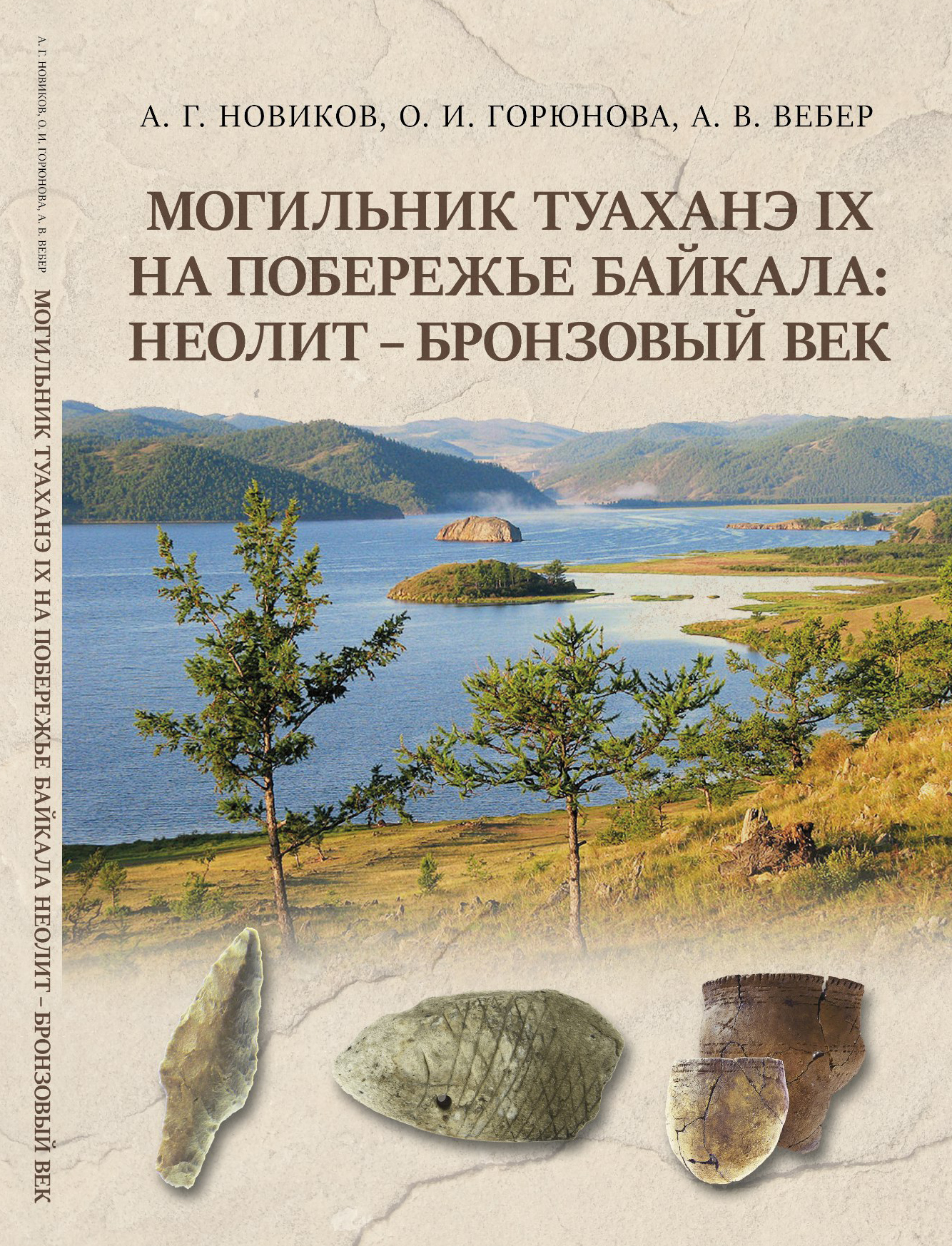
This monograph is dedicated to culture-historical analysis of the mortuary assemblages documented at Tuakhane IX – one of the large and completely excavated prehistoric cemeteries of the Cis-Baikal region. Tuakhane IX is located on the cape of the same name on the northwestern coast of the Mukhor Bay of the Little Sea part of Lake Baikal. Comprehensive excavations of this necropolis were carried out in 2019–2022 by the Russian–Canadian archaeological expedition (a joint project between the Research Center “Baikal Region”, Irkutsk State University, and the Department of Anthropology, University of Alberta, Edmonton, Canada). The cemetery dates to two chronologically different periods: the Late Neolithic and the Early Bronze Age. The bulk of the graves (24 of the 31) are Early Bronze Age.
The large volume of the new information provided by the excavated graves as well as the results of the broad range of scientific methods employed in the analysis of these materials made it possible to examine mortuary practices of these prehistoric groups at a qualitatively new level, to develop a typology of grave goods, to propose culture-historical reconstructions and, based on a large number of radiocarbon dates, to determine chronology of these new materials. The monograph employs a wide range of scientific methods from such fields as paleoanthropology, radiocarbon dating, zooarchaeology, mineralogical and petrographic identifications of lithic objects, as well chemical compositional data of metal objects. Stable isotope measurements of carbon and nitrogen (δ13C, δ15N) on samples of human bones were used to assess the diet of these groups.
In conclusion, this research supports previous findings with regard to the high level of detail about chronology of mortuary assemblages and dietary patterns of both the Late Neolithic and Early Bronze Age populations in the Little Sea microregion. Both components of the Tuakhane IX cemetery (i.e., Late Neolithic and Early Bronze Age) fit well into the previously developed models: chronological and dietary.
The main findings regarding mortuary practices, subsistence activities, and social differentiation are also consistent with the findings provided by examination of a few other large Early Bronze Age cemeteries in the of the Little Sea microregion such as Khuzhir-Nuge XIV, Kurma XI, and Khadarta IV, which, in turn, increases overall credibility of all these discoveries.