Weber

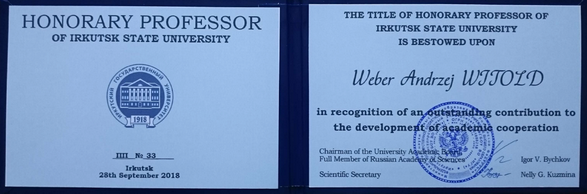
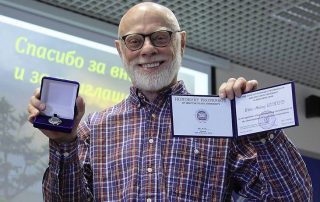
Dr. Andrzej Weber granted title of Honorary Professor of Irkutsk State University!

Congratulations to Dr. Andrzej Weber, BAP Project Director, who was recently granted the title of “Honorary Professor of Irkutsk State University” in recognition of his contribution to academic cooperation! Dr. Weber states “it was a huge surprise but so nice! :-)” Dr. Weber also gave a public lecture on Saturday, February 16, at the Irkutsk State University entitled “25 years of joint research by the Russian-Canadian archaeological expedition on Lake Baikal”. The lecture was filmed and is posted on Facebook [...]
2019-03-15T11:59:13-06:00Categories: News|Tags: |

Dr. Andrzej Weber gives public lecture at the Vancouver Institute, Vancouver, British Columbia, Canada

Dr. Andrzej Weber gave a public lecture at the Vancouver Institute, Vancouver, British Columbia, Canada on December 1, 2018. Location: The University of British Columbia - Lecture Hall No. 2, Woodward Instructional Resources Centre (2194 Health Sciences Mall) Title: Climate Change and Middle Holocene hunter-gatherers of the Baikal region in Siberia https://globalreportingcentre.org/climate-change-and-problem-solving-amongst-prehistoric-hunter-gatherers-a-case-study-from-lake-baikal/ Since 1916, the Vancouver Institute (https://globalreportingcentre.org/vancouver-institute/) has brought the University of British Columbia and Vancouver community together through free public lectures and discussions. Driven by volunteer membership and [...]

2019-03-15T12:01:53-06:00Categories: News, Media & Public Outreach|Tags: |

Using δ2H in Human Bone Collagen to Correct for Freshwater 14C Reservoir Offsets: A Pilot Study from Shamanka II, Lake Baikal, Southern Siberia

There is increasing awareness of the need to correct for freshwater as well as marine reservoir effects when undertaking radiocarbon (14C) dating of human remains. Here, we explore the use of stable hydrogen isotopes (δ2H), alongside the more commonly used stable carbon (δ13C) and nitrogen isotopes (δ15N), for correcting 14C freshwater reservoir offsets in 10 paired human-faunal dates from graves at the prehistoric cemetery of Shamanka II, Lake Baikal, southern Siberia. Excluding one individual showing no offset, the average [...]

2020-03-03T11:32:24-07:00Categories: Journal Articles, Publications|Tags: , , , |

Dr. Ian Scharlotta articles published in AJHB and IJO

Great news! Ian Scharlotta, Gwenaelle Goude, Estelle Herrscher, Vladimir Bazaliiskii, and Andrzej Weber recently had 2 articles published! Info below. First paper published in the American Journal of Human Biology. Title: "Mind the gap"-Assessing methods for aligning age determination and growth rate in multi-molar sequences of dietary isotopic data. Abstract: Objectives: Creating multi‐tooth sequences of micro‐sampled stable isotope (SI) analytical data can help track 20+ years of individual dietary history. Inferences about individual and population level behavioral patterns require [...]

2020-06-30T11:23:50-06:00Categories: News|Tags: , , , |

Shifting weaning practices in Early Neolithic Cis‐Baikal, Siberia: New insights from stable isotope analysis of molar micro‐samples

Reconstructing individual dietary histories at Shamanka II, an Early Neolithic (7000–5700 cal. BP) Kitoi hunter‐gatherer cemetery in Cis‐Baikal, Siberia, revealed surprising intrapopulation variability in childhood diets. Stable isotope analytical data produced by micro‐sampled first molars identified changes in both the timing and rate of weaning for different individuals. Further, examination within the framework of a high‐resolution radiocarbon chronology identified shifting practices between two phases of cemetery use, and additional links with mortuary treatment that indicates differences relating to group [...]

2020-06-30T11:00:20-06:00Categories: Publications, Journal Articles|Tags: , , , |

“Mind the gap”—Assessing methods for aligning age determination and growth rate in multi‐molar sequences of dietary isotopic data

Creating multi‐tooth sequences of micro‐sampled stable isotope (SI) analytical data can help track 20+ years of individual dietary history. Inferences about individual and population level behavioral patterns require cross‐calibration of the timing of dietary changes recorded by each tooth. Dentin sections from contemporaneous tissues (eg, in M1 and M2) reflect dietary signature for the time of growth. Contemporary sections should produce similar values, allowing alignment of temporally overlapping portions of teeth into multi‐tooth sequences. Published methods for determining [...]

2020-06-30T11:01:08-06:00Categories: Journal Articles, Publications|Tags: , , , |

Evaluating sodium hydroxide usage for stable isotope analysis of prehistoric human tooth dentine

Analyzing carbon and nitrogen stable isotopes (δ13C and δ15N) in serial samples of human tooth dentine can aid in reconstructing life history events such as weaning and diet. As dentine does not remodel after formation, it retains the isotopic signatures of the foods ingested during a tooth's development, allowing investigation of the diet consumed during this time. Microsampling human archaeological tissues is becoming increasingly popular but no consensus has been reached on the best method to remove soil humates from such small [...]

2019-12-03T12:18:05-07:00Categories: Journal Articles, Publications|Tags: , , |

Dr. Rick Schulting article in Radiocarbon

Congratulations to Dr. Rick Schulting and co-authors for the recent publication of their paper in Radiocarbon! Title: "Using δ2H in human bone collagen to correct for freshwater 14C reservoir offsets: A pilot study from Shamanka II, Lake Baikal, southern Siberia" Rick J Schulting • Christophe Snoeck • Ian Begley • Steve Brookes • Vladimir I Bazaliiskii• Christopher Bronk Ramsey • Andrzej Weber Radiocarbon, 2018, p. 1-12. Published online 18 July 2018. Abstract: There is increasing awareness of the need [...]

2020-06-30T11:28:36-06:00Categories: News|Tags: , , , |

Ancient human parvovirus B19 in Eurasia reveals its long-term association with humans

Human parvovirus B19 (B19V) is a ubiquitous human pathogen associated with a number of conditions, such as fifth disease in children and arthritis and arthralgias in adults. B19V is thought to evolve exceptionally rapidly among DNA viruses, with substitution rates previously estimated to be closer to those typical of RNA viruses. On the basis of genetic sequences up to ∼70 years of age, the most recent common ancestor of all B19V has been dated to the early 1800s, [...]

2020-06-30T11:02:15-06:00Categories: Publications, Journal Articles|Tags: , , |

Dr. Christian Leipe article in QSR

Congratulations to Dr. Christian Leipe for the recent publication of his article in Quaternary Science Reviews! Christian says it is a part of the BAP and he would like to share this wonderful good news with all team members. Title: "Vegetation change and human impacts on Rebun Island (Northwest Pacific) over the last 6000 years." Full reference: Leipe, C., Müller, S., Hille, K., Kato, H., Kobe, F., Schmidt, M., Seyffert, K., Spengler III, R., Wagner, M., Weber, A.W., Tarasov, [...]

2020-06-30T11:29:33-06:00Categories: News|Tags: , , , , |