Bazaliiskii

1

Archaeological Research in Asia March 2021

Middle Holocene hunter–gatherers of Cis-Baikal, Eastern Siberia: Chronology and dietary trends

Weber AW, Bronk Ramsey C, Schulting RJ, Bazaliiskii VI, Goriunova OI

Analyses of radiocarbon dates (all corrected for the freshwater reservoir effect) and associated stable isotope values obtained from the skeletal remains of ~650 individuals provide many new insights about Middle Holocene hunter–gatherers (HGs) of the Cis-Baikal region, Eastern Siberia. The new radiocarbon evidence clarifies the culture history of the region by defining better the boundaries between the chronological (archaeological periods) and cultural (mortuary traditions) units, as well as our understanding of the transitions between them. Furthermore, differences between [...]
2022-01-05T11:53:00-07:00Categories: Publications, Journal Articles|Tags: , , , , |
Archaeological Research in Asia March 2021

Skeletal and dental maturation relative to tooth formation in prehistoric hunter-gatherers from Cis-Baikal, Siberia

Temple DH, Lieverse AR, Bazaliiskii VI, Faccia K, Weber A

This study reconstructs fusion of skeletal elements and tooth emergence relative to tooth formation among prehistoric hunter-gatherers from Cis-Baikal, Siberia (ca. 8000 to 5200 BP). Tooth formation was recorded using standard protocols. Ages were estimated based on tooth formation stages within an individual. Tooth emergence was recorded as not emerged, emerged beyond the alveolus, or in occlusion. Skeletal epiphyses and apophyses were recorded as fused or unfused. Fisher’s exact tests were used to test heterogeneity in each developmental [...]

2021-12-07T10:32:06-07:00Categories: Publications, Journal Articles|Tags: , , , |
Science Advances September 2019

Nour Moussa article published in Archaeological Research in Asia

Leipe C, Long T, Sergusheva EA, Wagner M, Tarasov PE

Some great BAP news to share in the new year of 2021! Congratulations to Drs. Nour M. Moussa, Hugh G. McKenzie, Vladimir I. Bazaliiskii, Olga I. Goriunova and Andrzej W. Weber on the recent publication of their article in Archaeological Research in Asia! Title: Insights into Lake Baikal's ancient populations based on genetic evidence from the Early Neolithic Shamanka II and Early Bronze Age Kurma XI cemeteries Authors: Nour M. Moussa, Hugh G. McKenzie, Vladimir I. Bazaliiskii, Olga [...]

2021-03-22T10:17:26-06:00Categories: News|Tags: , , , , |
Archaeological Research in Asia March 2021

Insights into Lake Baikal’s ancient populations based on genetic evidence from the Early Neolithic Shamanka II and Early Bronze Age Kurma XI cemeteries

Moussa NM, McKenzie HG, Bazaliiskii VI, Goriunova OI, Bamforth F, Weber AW

Although previous ancient DNA research has contributed to the investigation of middle Holocene culture history and population dynamics in the Cis-Baikal, most of this work has been limited to the Angara valley and southwest Baikal, with only restricted genetic analysis of skeletal materials from the Little Sea microregion. In this paper, we expand upon initial findings by analyzing new mtDNA results from the EN/EBA Kurma XI cemetery (Little Sea area) and the EN Shamanka II cemetery (southwest Baikal). [...]

2021-10-05T16:31:35-06:00Categories: Publications, Journal Articles|Tags: , , , , |
Archaeological Research in Asia December 2020

Chronological and regional variation in developmental stress and behavior of Early and Late Neolithic Cis-Baikal hunter-gatherer juveniles: Insights from diaphyseal cross-sectional geometry

Osipov B, Harrington L, Temple D, Bazaliiskii VI, Weber AW

This study explores growth (increase in size) and development (change in structure and function) in Middle Holocene Cis-Baikal hunter-gatherer populations to evaluate chronological and regional variation in developmental health and juvenile behavior using post-cranial Cross-Sectional Geometry (CSG). It also evaluates whether sexual differences in size and habitual behavior were evident by the end of adolescence. Age and body size standardized femur, tibia, and humerus midshaft CSG are used to test for differences between Early Neolithic (EN) and Late [...]

2021-05-04T09:39:52-06:00Categories: Publications, Journal Articles|Tags: , , |

Rebecca Bourgeois and Lauren Michelman present at Canadian Association for Physical Anthropology Annual Meetings

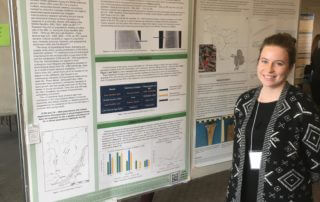
BAP was well represented by our University of Saskatchewan graduate students at the Canadian Association for Physical Anthropology 47th Annual Meetings held in Banff, Alberta, October 23-26, 2019. Rebecca Bourgeois presented a poster entitled: “Reconstructing Moy-Novaia-Shamanka, Siberia, Russia: Preliminary Analysis.” Rebecca L. Bourgeois, Angela R. Lieverse, Hugh G. McKenzie, Vladimir I. Bazaliiskii. Lauren Michelman presented a poster entitled: “Harris lines as indicators of physiological stress in the middle Holocene Cis-Baikal.” Lauren M. Michelman, Angela R. Lieverse. Link to Meeting: [...]

2019-11-18T12:17:24-07:00Categories: News|Tags: , , , , |
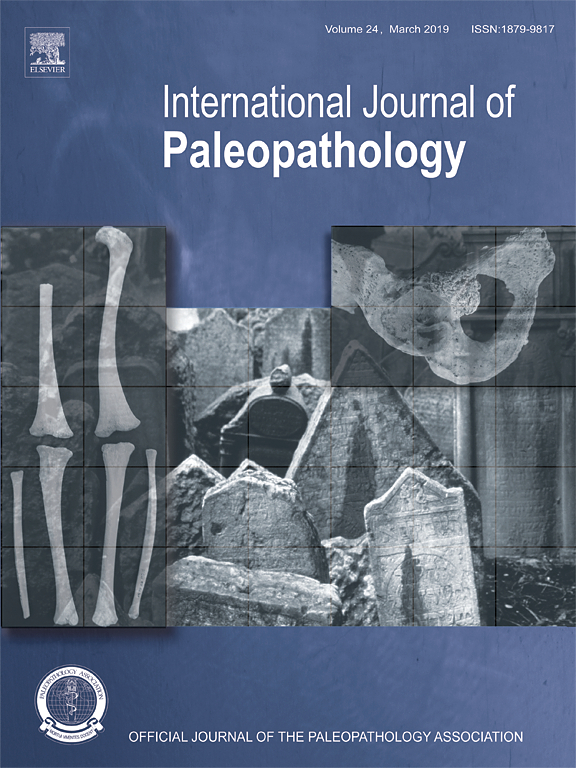
International Journal of Paleopathology, Volume 26, pages 22-26

Special Issue of Quaternary International with Pavel Tarasov as Guest Editor has been recently published!

Purchase, Samantha

Great news coming out of Germany! The new Special Issue of Quaternary International entitled "Climate change and human-environment interaction from Neolithic to historical times" with Pavel Tarasov as Guest Editor has been recently published. The Special Issue (Quaternary International 516 (2019) https://doi.org/10.1016/j.quaint.2019.06.004 contains a number of interesting articles. Among them three articles represent research of the current BAP members and cooperation partners. Leipe, C., Kobe, F., Müller, S., 2019. Testing the performance of sodium polytungstate and lithium heteropolytungstate as non-toxic [...]

2019-07-19T09:28:27-06:00Categories: News|Tags: , |
International Jounral of Paleopathology September 2019

An innovative method to visualise mastoiditis using a hand-held X-ray system

Purchase S, Bazaliiskii V, Lieverse AR

Objective: We explore the utility of using a hand-held X-ray system to diagnose mastoiditis in archaeological populations. Materials: A sample (n = 56) of hunter-fisher-gatherers from the Early Neolithic (8,000–7,000/6,800 cal. BP) Cis-Baikal cemetery of Shamanka II (Russia) were examined. Methods: Images were taken medio-laterally, approximately 90° to a sensor temporarily affixed to the lateral surface of the mastoid process. Digital radiographs were analysed for signs of mastoiditis occurring pre- and/or post-puberty. Results: Two thirds of individuals (39/56) exhibited evidence of [...]

2020-05-05T10:25:55-06:00Categories: Publications, Journal Articles|Tags: , |
International Journal of Paleopathology, Volume 26, pages 22-26

Samantha Purchase first paper as lead author on BAP materials published in International Journal of Paleopathology!

Purchase, Samantha

Congratulations to Samantha Purchase, former BAP Master's student supervised by Dr. Angela Lieverse, on the publication of her first paper as lead author! The paper will appear in the September 2019 issue of the International Journal of Paleopathology, Volume 26, pages 22-26, and is now available online! Title: An innovative method to visualise mastoiditis using a hand-held X-ray system Authors: Samantha Purchase, Vladimir Bazaliiskii, Angela Lieverse ABSTRACT Objective: We explore the utility of using a hand-held X-ray system to [...]

2020-06-30T11:17:23-06:00Categories: News|Tags: , |
Radiocarbon October 2018

Using δ2H in Human Bone Collagen to Correct for Freshwater 14C Reservoir Offsets: A Pilot Study from Shamanka II, Lake Baikal, Southern Siberia

Schulting RJ, Snoeck C, Begley I, Brookes S, Bazaliiskii VI, Ramsey CB, Weber AW

There is increasing awareness of the need to correct for freshwater as well as marine reservoir effects when undertaking radiocarbon (14C) dating of human remains. Here, we explore the use of stable hydrogen isotopes (δ2H), alongside the more commonly used stable carbon (δ13C) and nitrogen isotopes (δ15N), for correcting 14C freshwater reservoir offsets in 10 paired human-faunal dates from graves at the prehistoric cemetery of Shamanka II, Lake Baikal, southern Siberia. Excluding one individual showing no offset, the average [...]

2020-03-03T11:32:24-07:00Categories: Journal Articles, Publications|Tags: , , , |